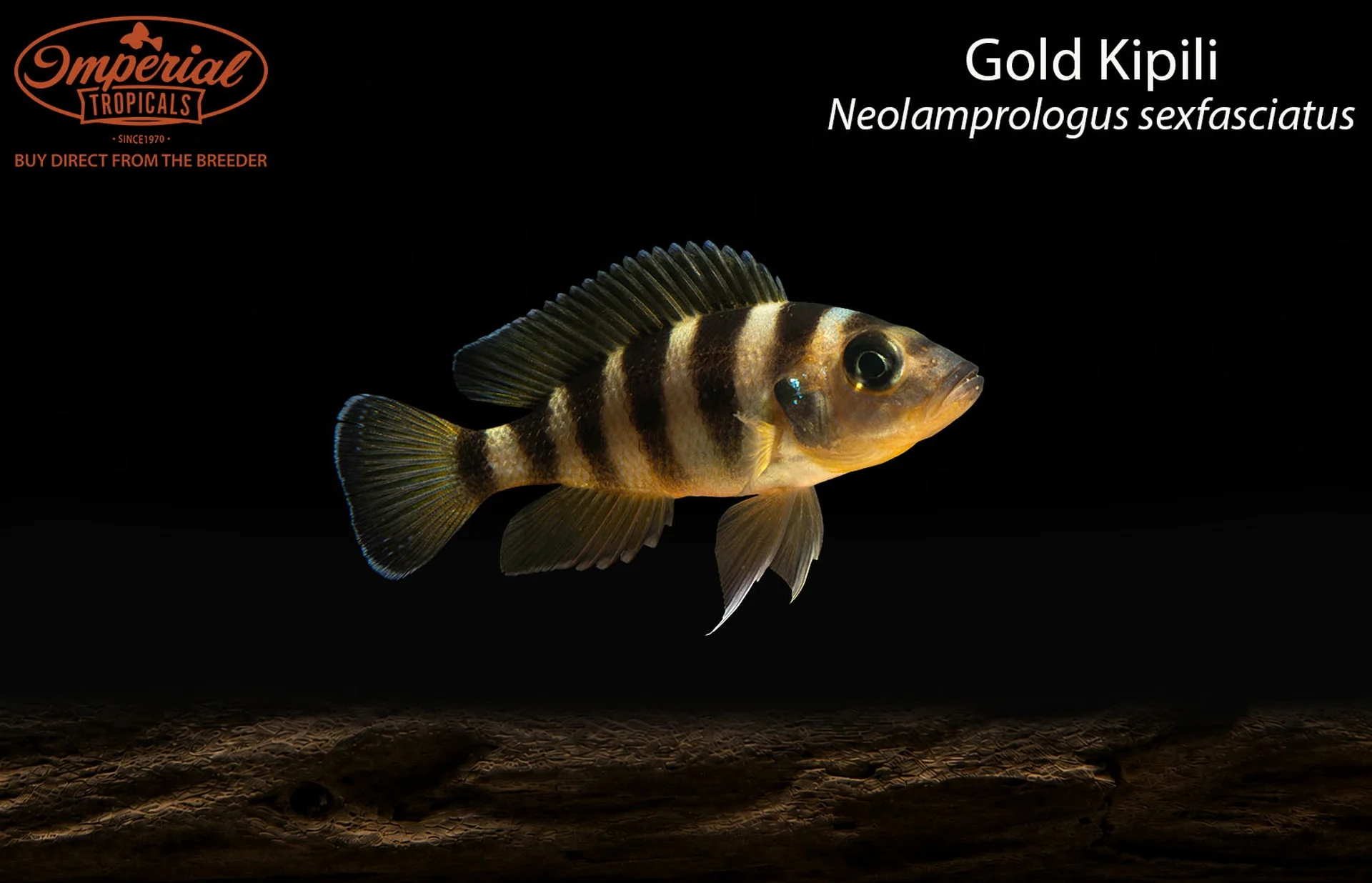
Gold Kipili (Neolamprologus sexfasciatus)
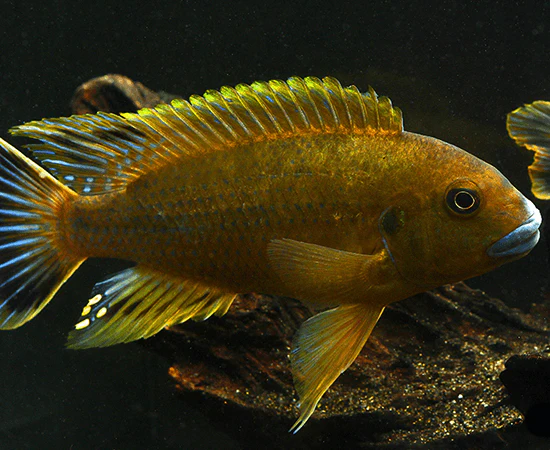
The gold Kipili variant of Neolamprologus sexfasciatus can be found in the rocky shallows of the southeastern side of Lake Tanganyika near Kipili, Tanzania. There, it can be found in pairs inhabiting crevices between rocks. Gold Kipili kept within the home aquarium will thrive best when their natural habitat is replicated with a sandy substrate and plenty of rocky caves. The more caves and breaks in their line of sight, the less aggression will be displayed.
While gold Kipili are far more manageable than their blue counterparts, they are still a particularly feisty cichlid. They should not be kept with more timid and slow moving tankmates, but they can get along with more robust Tanganyikans provided enough space and caves are provided. While a lone pair can be kept in a 40-gallon aquarium, 75 gallons or more is recommended if they are being kept in a community setting. Being voracious predators, gold Kipili will hunt down fish small enough to fit in their mouths so great consideration should be given when choosing tankmates. So long as these aspects of their personalities are kept in mind, unlike the blue variant, it is possible to have a gold Kipili as a member of a more robust Tanganyikan community.
If looking to breed gold Kipili, they are best kept in a species only tank as a solitary pair. This is because when spawning, their aggression gets far worse with the male viciously guarding the cave in which the female chooses to lay her eggs. Of course, one must obtain a pair before they are able to breed this species which can be a challenge as just having a male and female will not guarantee they will pair off. Rather, one should get a group of at least six juveniles and allow pairs to form naturally as they grow, a process that can take up to a year. Since males and females only differ in that males are slightly larger, you will only be able to tell a pair has formed based on behavior so close monitoring is key. Once pairs have formed, they should be separated as soon as possible as the aggression of spawning pairs is far worse toward their own kind and conspecifics.
After a pair has been established, the female will lay her eggs within a cave selected by the pair. Gold Kipili are notably prolific once they start spawning as eggs can number around 500 per spawn. She will tend to the eggs and fry until they are around 2-3 weeks of age while the male guards the cave. Afterwards, the male will actually chase off the female and fully take over brood care until the fry are around 4 months of age at which point they will disperse. It is very important when breeding gold Kipili that you have a back-up holding tank to place the female in as the male can get extremely aggressive with her outside of spawning or when he takes over brood care. While these feisty cichlids can be a challenge to breed, their vibrant colors and fascinating behavior make them a worthy challenge for anyone looking to keep them.
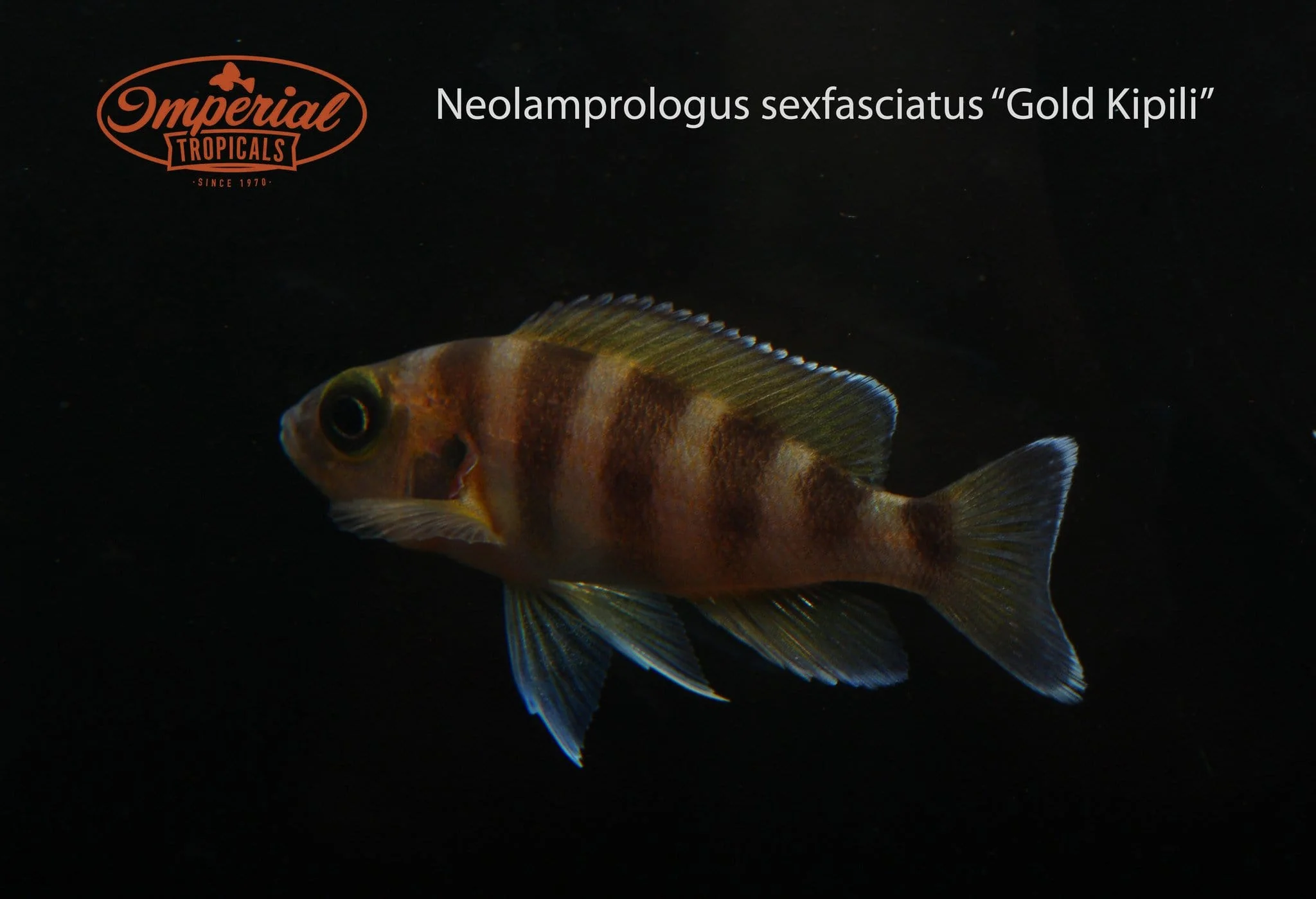
Description
The gold Kipili variant of Neolamprologus sexfasciatus can be found in the rocky shallows of the southeastern side of Lake Tanganyika near Kipili, Tanzania. There, it can be found in pairs inhabiting crevices between rocks. Gold Kipili kept within the home aquarium will thrive best when their natural habitat is replicated with a sandy substrate and plenty of rocky caves. The more caves and breaks in their line of sight, the less aggression will be displayed.
While gold Kipili are far more manageable than their blue counterparts, they are still a particularly feisty cichlid. They should not be kept with more timid and slow moving tankmates, but they can get along with more robust Tanganyikans provided enough space and caves are provided. While a lone pair can be kept in a 40-gallon aquarium, 75 gallons or more is recommended if they are being kept in a community setting. Being voracious predators, gold Kipili will hunt down fish small enough to fit in their mouths so great consideration should be given when choosing tankmates. So long as these aspects of their personalities are kept in mind, unlike the blue variant, it is possible to have a gold Kipili as a member of a more robust Tanganyikan community.
If looking to breed gold Kipili, they are best kept in a species only tank as a solitary pair. This is because when spawning, their aggression gets far worse with the male viciously guarding the cave in which the female chooses to lay her eggs. Of course, one must obtain a pair before they are able to breed this species which can be a challenge as just having a male and female will not guarantee they will pair off. Rather, one should get a group of at least six juveniles and allow pairs to form naturally as they grow, a process that can take up to a year. Since males and females only differ in that males are slightly larger, you will only be able to tell a pair has formed based on behavior so close monitoring is key. Once pairs have formed, they should be separated as soon as possible as the aggression of spawning pairs is far worse toward their own kind and conspecifics.
After a pair has been established, the female will lay her eggs within a cave selected by the pair. Gold Kipili are notably prolific once they start spawning as eggs can number around 500 per spawn. She will tend to the eggs and fry until they are around 2-3 weeks of age while the male guards the cave. Afterwards, the male will actually chase off the female and fully take over brood care until the fry are around 4 months of age at which point they will disperse. It is very important when breeding gold Kipili that you have a back-up holding tank to place the female in as the male can get extremely aggressive with her outside of spawning or when he takes over brood care. While these feisty cichlids can be a challenge to breed, their vibrant colors and fascinating behavior make them a worthy challenge for anyone looking to keep them.